
Learning in Confinement
Article Sidebar
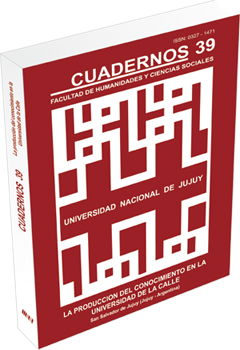
Main Article Content
Abstract
“Learning in Confinement” is a research setting framed within the University of the Street Project. Its protagonists are adolescents detained for various offenses in Penal No. 2, commonly known as the Juvenile Detention Center, since it houses adolescents between 16 and 21 years of age.
The purpose of this work is to inquire into the forms of learning that emerge during subjects’ interaction in everyday life. In Penal No. 2, there are adolescents who have intuitively developed the role of “prisoners” or inmates, assimilating this learning through coexistence. An inmate is understood as a person deprived of liberty, in accordance with Penal Enforcement Law No. 24660, whose legal status is that of a defendant or a convicted person, depending on whether or not a sentence has been issued in his judicial case.
The adolescent becomes an inmate from the moment he enters the correctional facility, but he does not assimilate this condition until his days gradually pass as a peer among other adolescents and as a detainee within the institution. In these relationships with peers and with the authorities of the facility, the inmate gradually deduces, beyond the suggestions of third parties, what is or is not convenient for him to do in order to live better or to come out well in a given situation.
The research process was developed through interviews and direct observations of their behavior in the setting.
The analysis of the data obtained was approached from the perspective of Indicial Semiotics and Social Cognition.
So far, two types of learning have been detected: one by imitation and another by the assimilation of suggestions at the institutional and group levels.
In this way, the circulation of the forms of knowledge of the “University of the Street” was identified in the construction of the life of an adolescent who becomes an inmate.
Downloads
Article Details

This work is licensed under a Creative Commons Attribution-NonCommercial-ShareAlike 4.0 International License.
The author/s grant exclusive license without temporary limit for the manuscript to be published in Cuadernos-FHyCS edited by Humanides the Faculty of Social Science, National University of Jujuy.
References
Conte, R. y Paolucci, M. (2001) Intelligent social learning. Journal of Artificial Societies and Social Simulation, 4, (1).
Magariños de Morentin, J. (2003) Hacia una semiótica indicial. A Coruña, Ediciós do Castro.
Wenger, E. (2001) Comunidades de práctica: aprendizaje, significado e identidad. (Trad. G. Sánchez Barberán). Barcelona, Editorial Paidós. Disponible en línea: http://www.universidad-de-la-calle.com.