
Crossroads of Communication: On the Landscape of Career Journalists
Article Sidebar
Main Article Content
Abstract
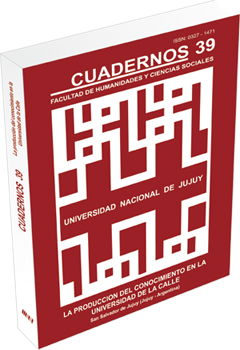
The aim of this paper is to analyze the links established between the field of Social Communication and the project “University of the Street” as an innovative contribution to academic research in the field of media communication.
The possibility of identifying non-formal learning situations in journalistic activity allows us to shed light on dimensions of analysis that have been little explored by theories of communication and culture. These are “experience-generating behaviors” (J. Magariños, 2006) which, because of their effectiveness in professional practice, condense forms of learning that may be taken up again and updated by subjects in other contexts or situations.
These “acquired experiential forms of knowledge” are generally denied or only scarcely addressed by communication studies. In this sense, the identification and construction of the scenario “Journalists by Trade” posed the challenge of systematizing these non-academic forms of knowledge from a basic methodology.
The identification and description of teachings accumulated by a large number of journalists who have not had access to university education made it possible, initially, to notice the intersections and tensions with the knowledge produced by academia and with which the latter seeks to differentiate itself in its search for labor-market insertion for its graduates.
Downloads
Article Details

This work is licensed under a Creative Commons Attribution-NonCommercial-ShareAlike 4.0 International License.
The author/s grant exclusive license without temporary limit for the manuscript to be published in Cuadernos-FHyCS edited by Humanides the Faculty of Social Science, National University of Jujuy.
References
Beneyto, J. (1945) La prensa en el trance agónico de la cultura. En: J. Beneyto, Lección sabida: política de letras y de historia. Madrid, Editora Nacional.
Beneyto, J. (1957) El periodismo como técnica y como cultura. Barcelona, Escuela Oficial de Periodismo.
Bourdieu, P. (1981) The Logic of Practice. Stanford, Stanford University Press.
Certeau, M. de (1979) La invención de lo cotidiano. (Trad. A. Pescador). México, Universidad Iberoamericana.
Foucault, M. (1970) La arqueología del saber. (Trad. A. Garzón del Camino). México, Siglo XXI Editores.
Hall, S. (1984) Notas sobre la desconstrucción de «lo popular». En: R. Samuel (Ed.), Historia popular y teoría socialista. (Trad. J. A. Matesanz). Barcelona, Editorial Crítica, pp. 93-110.
Hall, S. (1987) Blue election, election blues. Marxism Today, julio de 1987, pp. 30-35. Londres.
Magariños de Morentin, J. A. (1996) Los fundamentos lógicos de la semiótica y su práctica. Buenos Aires, Edicial.
Magariños de Morentin, J. A. (2003) Hacia una semiótica indicial: acerca de la interpretación de los objetos y los comportamientos. A Coruña, Ediciós do Castro.
Uranga, W. (2001) Una propuesta académica con la mirada en las prácticas sociales. En: Documento curricular: Maestría en Planificación y Gestión de Procesos Comunicacionales. La Plata, Universidad Nacional de La Plata, Facultad de Periodismo y Comunicación Social, Investigaciones PLANGESCO.
Vassallo de Lopes, M. I. (2000) El campo de la comunicación: reflexiones sobre su estatuto disciplinar. Oficios Terrestres, 6, (7-8), pp. 14-23. La Plata, Universidad Nacional de La Plata, Facultad de Periodismo y Comunicación Social.
Wenger, E. (2001) Comunidades de práctica: aprendizaje, significado e identidad. (Trad. G. Sánchez Barberán). Barcelona, Editorial Paidós.