
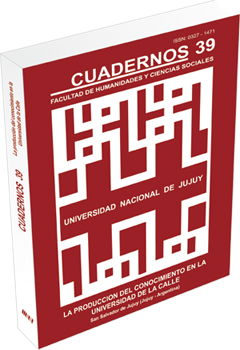
“M’hijo el dotor” as Son and Protagonist of the “University of the Street”
Article Sidebar
Main Article Content
Abstract
The University of the Street (UDELAC) was surely part of the thought of a period and of a large part of Argentine society, synthesized in the expression “m’hijo el dotor” (“my son, the doctor”). This expression guided the ideals of a broad sector of Argentine society during a period that may tentatively be located between the last two decades of the nineteenth century and the first seven decades of the twentieth century, and it was a fundamental ideological ingredient in the generation of a model of the country.
In its early stages, this mainly involved, especially in the so-called “Pampa Gringa”, the first or second generation of European immigrants, who saw in the public and free university the instrument through which their children would not have to suffer the poverty they themselves had endured. The most attractive option observable in the social landscape of economically successful people at the time was represented by the “doctors”, especially lawyers and physicians. The possibility emerged that, without the support of a family fortune, one could rise socially and achieve the long-desired economic well-being.
This sense, within UDELAC, of the need for social advancement through university studies in the liberal professions persisted—and still persists—longer in rural areas and in the poorest areas of the country, with more asymmetrical social structures, characterized by a greater proportion of population of Creole origin.
Little by little, the mechanisms and strategies of the University of the Street, which had originally been defined and understood as an unquestionable counterposition to the formal university institution, began to take over many aspects that belong to the essence of the university system.
This text is written by appealing to certain resources of both systems of thought and action, with the purpose of addressing the aim of achieving an adequate integration that remains faithful to the forms of the university in the present.
Downloads
Article Details

This work is licensed under a Creative Commons Attribution-NonCommercial-ShareAlike 4.0 International License.
The author/s grant exclusive license without temporary limit for the manuscript to be published in Cuadernos-FHyCS edited by Humanides the Faculty of Social Science, National University of Jujuy.
References
Avni, H. y Seibert, S. (1983) La agricultura judía en la Argentina: ¿éxito o fracaso? Desarrollo Económico, 22, (88), pp. 535-548. Buenos Aires, Instituto de Desarrollo Económico y Social (IDES).
Becher, T. (2001) Tribus y territorios académicos: la indagación intelectual y las culturas de las disciplinas. (Trad. A. Giordano). Barcelona, Editorial Gedisa.
Berruti, M. E. (2009) Discurso crítico y construcción de identidades. En: H. Aguilar y M. Moyano (Comps.), Aportes y desarrollos sobre la construcción discursiva de la identidad. Río Cuarto, Universidad Nacional de Río Cuarto (UNRC), pp. 61-70.
González de la Fuente, I. (2007) Quien no tranza, no avanza: una aproximación etnográfica al clientelismo político en México. Nuevo Mundo Mundos Nuevos, (7). Disponible en línea: http://nuevomundo.revues.org/document3191.html. Consultado el 20 de abril de 2008.
Gutiérrez, L. y Romero, L. A. (1989) Sociedades barriales, bibliotecas populares y cultura de los sectores populares: Buenos Aires, 1920-1945. Desarrollo Económico, 29, (113), pp. 33-62. Buenos Aires, Instituto de Desarrollo Económico y Social (IDES).
LaCapra, D. (2007) ¿La universidad en ruinas? En: D. LaCapra, Historia en tránsito: experiencia, identidad, teoría crítica. (Trad. E. Marengo). Buenos Aires, Fondo de Cultura Económica, pp. 261-328.
Morote, H. (1992) Réquiem por Perú, mi patria. Lima, Editorial Horizonte. Disponible en línea: http://www.herbertmorote.com/Libros/Requiem_Por_Peru.pdf.
Sánchez, F. (2005) M'hijo el dotor. Buenos Aires, Editorial Santiago Rueda.
Schwartz Lerner, L. (1986) El letrado en la sátira de Quevedo. Hispanic Review, 54, (1), pp. 27-46. Filadelfia, University of Pennsylvania Press.