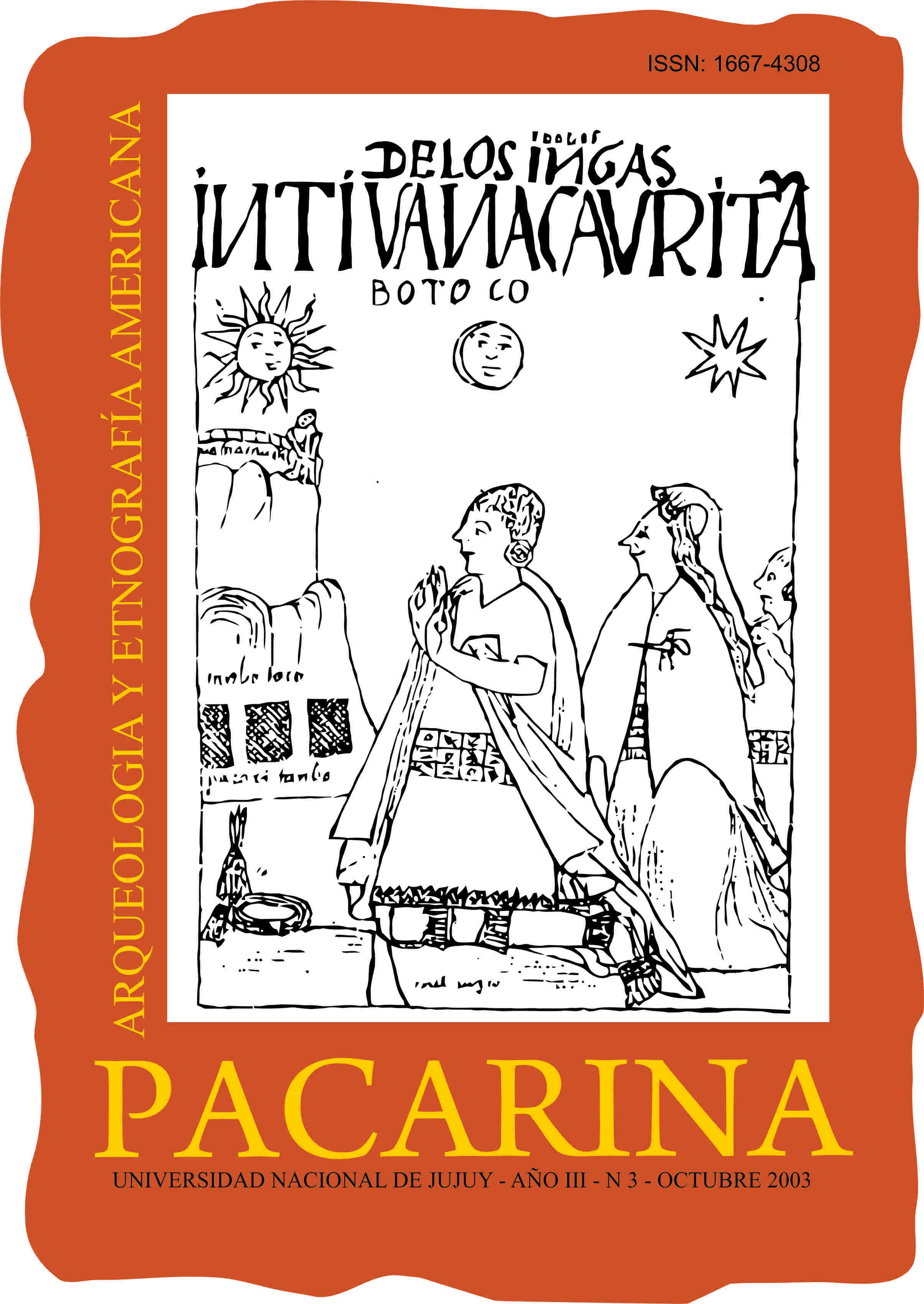
MORENO” AND ERIC BOMAN
A ONE HUNDRED YEARS´ HISTORY
Abstract
The settlement known as “El Moreno” has gone a long way throughout the 20th Century. Moreno is included in the Argentine territory consolidation during the Argentine National government. I was determined to explore and know all the possible resources for export, with to intention of incorporating this vast region into the national society, sponsoring a number of different specialities (agronomists, geologists, naturalists, archeologists, etc.) that in the last decades of the 19th Century, travelled in the Puna, such as Philipp (1860), Brakebush (1883), Holmeberg (1900), Boman (1901 y 1908) Von Rosen and others that were joined by government officials to see the situation in the ´Puna´.
Cerri and Sanchez de Bustamante. Because of their contribution we can say that, some of them with greater descriptive than others, some of them true chroniclers due to the comprehensiveness and wealth of their stories, but all of them wrote reports that were about detailed observations that have come to us like a picture that shows us the landscape and societies they visited.
We have read the description carried out by Boman about this community at the turn of the Century. (1900) Boman says “There are many traces of a prehispanic population and documents which demonstrate that this place was permanentely inhabited from the begining of the Spanish conquest”. Because of all these it´s a very agreeable situation next to a fresh water stream, I cannot
doubt “El Moreno is “Tambo El Moreno de Matienzo” Boman also mentions in his work a number of details he was able to see while he was at “El Moreno”, there he saw the way Mrs Ana Sorich the owner of “El Moreno´s wife, treated the indians. That is to say that considering this report and investigating the so called ´evolution´? From their primitive state of bondage Boman found them to
becoming Argentine citizens, though marginal ones, to their current situation.
Nowadays “El Moreno” population is constituted by an urban settlement together with its rural surroundings that includes about eighty families. Nonetheless in this process of “growing urbanization of rural dwellers”, we have found there has also been a social phenomenon of citizens trying to recover their history. This has been produced because people have a new identity status, they want to reconstruct their aboriginal identity, expressed in the creation of an aborigenal organization “Sol de Mayo”, they get in contact with other communities as well as with the State through this organization.
This research work is about the process developed in this period, experiences expressed by present actors and their present reflection on their recent past and their implications of the community’s present and future.
Downloads
References
ALBECK, M. (comp.) (1994)De costa a selva. Producción e intercambio entre los pueblos agroalfareros de los Andes Centro Sur. Taller realizado en el IIT., 6 al 11 de abril de 1992- IIT. UBA. Tilcara.
ARGAÑARAZ, C. (1995) Participación comunitaria y acciones de desarrollo. Estudio de un caso: El Moreno, una comunidad de la Puna Argentina. Trabajo de Tesis para obtener el Diploma Superior en Ciencias Sociales presentado ante el Centro Bartolomé de las Casas- FLACSO. Cuzco - Perú.
BENEDETTI, A. (1998) Electricidad y vida cotidiana en El Moreno. Un estudio sobre energización rural y condiciones de reproducción social en pequeñas comunidades rurales. Tesis de Licenciatura en Geografía. Universidad de Buenos Aires.
BELLI,E. T SLAVUTSKY, R. (1997) La modernidad agrietada. Los procesos políticos en Jujuy, IIT. F.F. yL.- UBA. Tilcara.
BOMAN, E. (1908) Antiquité de la región de la republique Argentine et du Desert d’Atacama. Libriere H. Le Souldier, Paris, Francia.
BRACKEBUSCH, L. (1990) Por los caminos del norte. UNJu, San Salvador de Jujuy.
CATALANO, L. (1930) Puna de Atacama (Territorio de los Andes) Reseña geológica y geográfica. Universidad Naciona del Litoral.
CEPAL-Naciones Unidas (1993) America Latina: Información censal sobre pueblos indígenas. En Notas sobre la economía y el desarrollo N º 535. Santiago de Chile-Cerri, D. (1903) El territorio de los Andes (República Argentina). Talleres Topográficos de la Penitenciaría. Nacional. Buenos Aires.
DE BERAUX G. (1988) (Comp) Personalidad Etnica versus Identidad Etnica. En Etnosicoanálisis complemetarista.
FERNÁNDEZ DISTEL, A. (1997) Jujuy: Diccionario Arqueológico. Salta
FERREIRO J.P. (1994)El Chaco en los Andes, Churumatas, Paypayas,Yalas y Ocloyas en la Etnografía del Oriente Jujeño. En: Población y Sociedad. Revista regional de Estudios Sociales Nº2. San Miguel de Tucumán.
GUERRERO, A.(1990) La semántica de la dominación, el Concertaje de Indios. Editorial Libris Mundi, Quito,Ecuador.
GUNDERMAN KROLL, H. (1995) Comunidad indígena y ciudadanía. La experiencia aymara en el Norte de Chile. En Alpanchis, N º46, Pastorial Andina XXVII. Cuzco, Perú.
ISLA, A. (1992) (comp.) Dos regiones, un origen. Entre el Silencio y la Furia.En Isla - Rutledge, I. (1992) “La rebelión de los campesinos en las tierras altas del norte argentino.1872-1875. En Islas A. (comp..) Sociedad y articulación en las tierras altas jujeñas. Crisis terminal de un modelo de desarrollo. Proyecto
ECIRA-ASAL-MLAL, San Salvador de Jujuy.
SÁNCHEZ, S. - SICA, G. (1992) Algunas reflexiones acerca de los tilcaras. En Avances de Arqueología. IIT. FFL-UBA. Tilcara.