
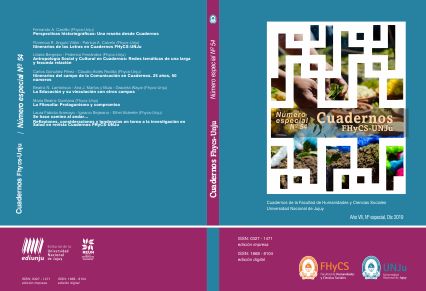
Itineraries in the field of Communication in Cuadernos Journal. 25 years,50 numbers
Article Sidebar
Main Article Content
Abstract
The methodology used was that of grouping the articles into axes by thematic linkage. Then We tried to present the fundamentals of each of these axes, with a specific reference to each work, in chronological order of publication. The four articulating axes of specific problems within the field of communication are: Media: discourses, consumption and mediations; Communication, representations, identities and popular culture; Communication and Semiotics; Openness and diversity of problems with multidisciplinary approaches.
In this way, the article presents an itinerary that allows us to reflect the tensions and conflicts within each research proposal, which we consider to be a very remarkable aspect on the part of a scientific journal, whose purpose is, precisely, to be able to promote debates, exchanges and discussions in relation to the social sciences, in this case. This review also allows us to argue that the diversity of theoretical objects of communication is still a current aspect of the field, and its approach is nourished by interdisciplinary perspectives: anthropology, semiotics, psychology, etc.
Downloads
Article Details

This work is licensed under a Creative Commons Attribution-NonCommercial-ShareAlike 4.0 International License.
The author/s grant exclusive license without temporary limit for the manuscript to be published in Cuadernos-FHyCS edited by Humanides the Faculty of Social Science, National University of Jujuy.
References
Avilés Rodilla, C.; Brunet, M. y González Pérez, C. (2015) Comunicación desde los bordes. Consolidación e institucionalización de un campo científico en movimiento. Revista Viator, 1, 13-33.
Bourdieu, P.; Chamboredon, J. y Passeron, J. (2001) El oficio de Sociólogo. Buenos Aires, Siglo XXI Editores.
Follari, R. (2010) La necesidad de lo epistemológico en Comunicación. En ARRUETA, C; BRUNET, M y GUZMÁN, J (Eds.) La Comunicación como objeto de estudio. Teoría, Metodología y Experiencias de investigación (pp. 17-36). San Salvador de Jujuy, UCSE-DASS.
Karam, T. (2013) Semiótica: problemas y recorridos. Homenajea a Juan Magariños de Morentin. San Salvador de Jujuy, EdiUNJu.
Galindo Cáceres, J.; Karam, T. y Rizo García, M. (2005) Cien libros hacia una Comunicología posible. México, Universidad Autónoma de la Ciudad de México.
González Pérez, C. (2016) Semiótica y organizaciones. Aplicaciones de operaciones en el estudio de la comunicación organizacional interna: hacia la integración de lo formal/informal. San Salvador de Jujuy, EdiUNJu.
Huergo, J. (2007) Los medios y tecnologías en educación. Revista Iberoamericana de comunicación, 3 – 4, 1 - 20.
Martino, L. (2005) Elementos para una epistemología de la Comunicación. En VASALLO DE LOPEZ, M y FUENTES, R (Comps.) Comunicación, campo y objeto de estudio: perspectivas para reflexivas latinoamericanas. México, ITESO.
Peirce, C.S. (1965/1931) Collected Papers of Charles Sanders Peirce, Hartshorne, P. Weiss y A. W. Burks (eds.), Cambridge, Harvard University Press, MA, Cambridge, The Belknap Press of Harvard University Press.
Quevedo, L.A. (1996) Televisión y política en el nuevo espacio público. Revista Cuadernos FHyCS-UNJu, 6, 143-149.
Uranga, W. (2010) Acerca del objeto de estudio y el estudio del objeto. En ARRUETA, C; BRUNET, M y GUZMÁN, J (Eds.) La Comunicación como objeto de estudio. Teoría, Metodología y Experiencias de investigación (pp. 9-14). San Salvador de Jujuy, UCSE-DASS.